- Website content (via URLs)
- Documents:
.bmp,.csv,.doc,.docx,.eml,.epub,.heic,.html,.jpeg,.png,.md,.msg,.odt,.org,.p7s,.pdf,.ppt,.pptx,.rst,.rtf,.tiff,.txt,.tsv,.xls,.xlsx,.xml - Custom text snippets
How It Works
Create a knowledge base and link it to your agent. When linked, the agent automatically searches the knowledge base before every response — no prompt changes needed. At creation time: sources are chunked, embedded, and stored in a vector database. During a call: before responding, the agent uses the conversation transcript to find the most relevant chunks and feeds them to the LLM as context under## Related Knowledge Base Contexts.
Auto-Refreshing and Auto-Crawling
For URL sources, you can enable:- Auto-refreshing — re-fetches all URLs every 24 hours to keep content current
- Auto-crawling — crawls all pages under specified URL paths every 24 hours, excluding any URLs on the exclusion list
Limits
Best Practices
- Prefer
.md(Markdown) files over.txt— structured Markdown is chunked and retrieved more accurately - Use clear, descriptive headings; split long sections into
##/###subsections - Write short paragraphs and lists; avoid walls of text
- Avoid ambiguous pronouns like “it” or “this” — prior chunks won’t be present, so references must be self-contained
- Use specific URL paths for auto-crawling instead of broad paths with many exclusions
- Put supporting information in the knowledge base; put agent instructions in the prompt
Setup
1
Access Knowledge Base settings
In the top navigation bar under Agents, navigate to Knowledge Bases and click Create Knowledge Base.

1
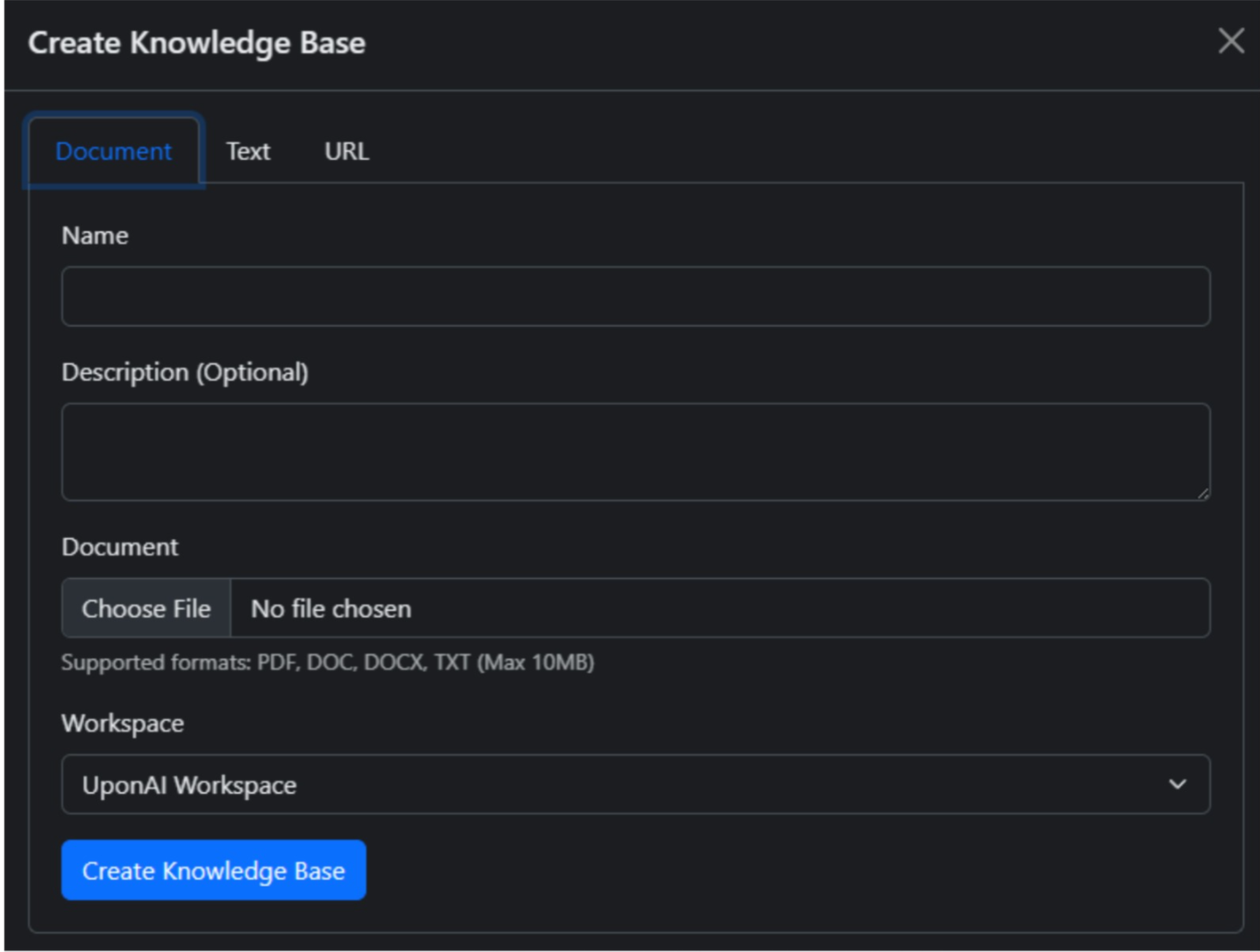
Add sources
Choose a source type:
- URL — import from web pages; supports single pages or full sites
- File — upload documents (PDF, TXT, DOCX, etc.), max 50 MB
- Text — paste or type custom content directly
1
Enable auto-crawling (optional)
Enable auto-crawling for specific URL paths. URLs not selected will be added to the exclusion list.
2
Connect to your agent
Once created (may take a few minutes), go into your agent, navigate to Knowledge Base on the right, click Add Knowledge Base, select your knowledge base, then click Save.
3
Configure retrieval settings
Adjust KB Retrieval Chunks and Similarity:
- Chunks to retrieve — max chunks returned per response (range 1–10, default: 3)
- Similarity threshold — how strictly chunks must match the context (default: 0.60)
Default settings (3 chunks, 0.60 threshold) work well for most cases. Increasing chunks gives more context but raises prompt length and can reduce generation quality.
4
Set node-level knowledge base (Conversation Flow only)
For Conversation Flow agents, attach a knowledge base to individual Conversation Nodes or Subagent Nodes for more focused context on specific topics.
FAQ
Do I need to change my prompt to use a knowledge base? No. The knowledge base retrieves automatically on every response. How can I prevent the LLM from generating information not in the knowledge base? Add instructions like “Only answer based on the information provided. If you don’t know, say so.” to your prompt. Will this add latency to calls? Retrieval adds a small amount of latency — typically under 200ms. Is there a way to check what’s being retrieved? Yes — the dashboard call logs show which chunks were retrieved for each response.Pricing
The per-minute charge is the same regardless of how many knowledge bases are linked to the agent.
Post Call Analysis
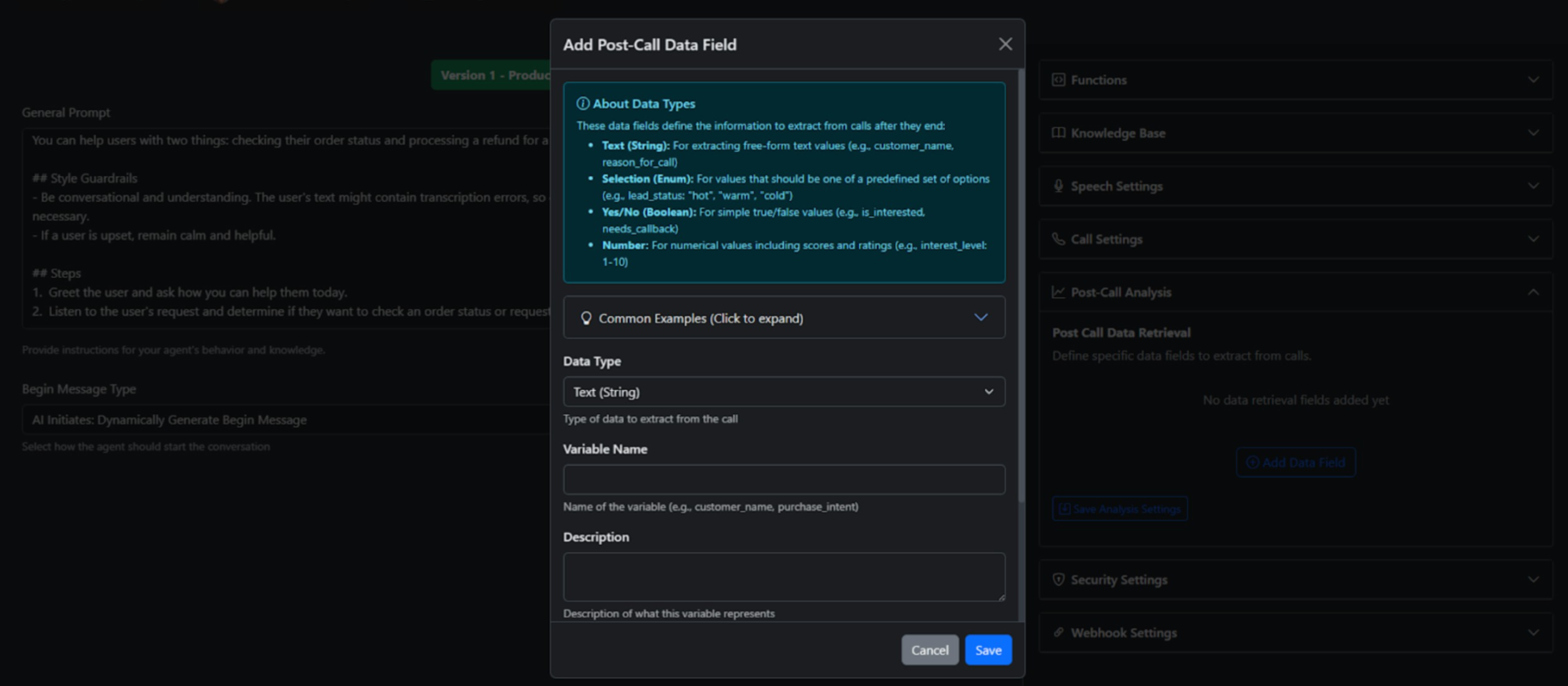
Post-call analysis automatically analyzes conversations after they end, helping you derive insights from your calls. Several built-in analysis categories are available under Common Examples in your agent settings.Adding Post-Call Analysis Data Fields
- Under Post-Call Analysis, click Add Data Field
- Add data types you want the agent to retrieve
- This data appears in your CDR, emails, and SMS (if opted in via webhook)